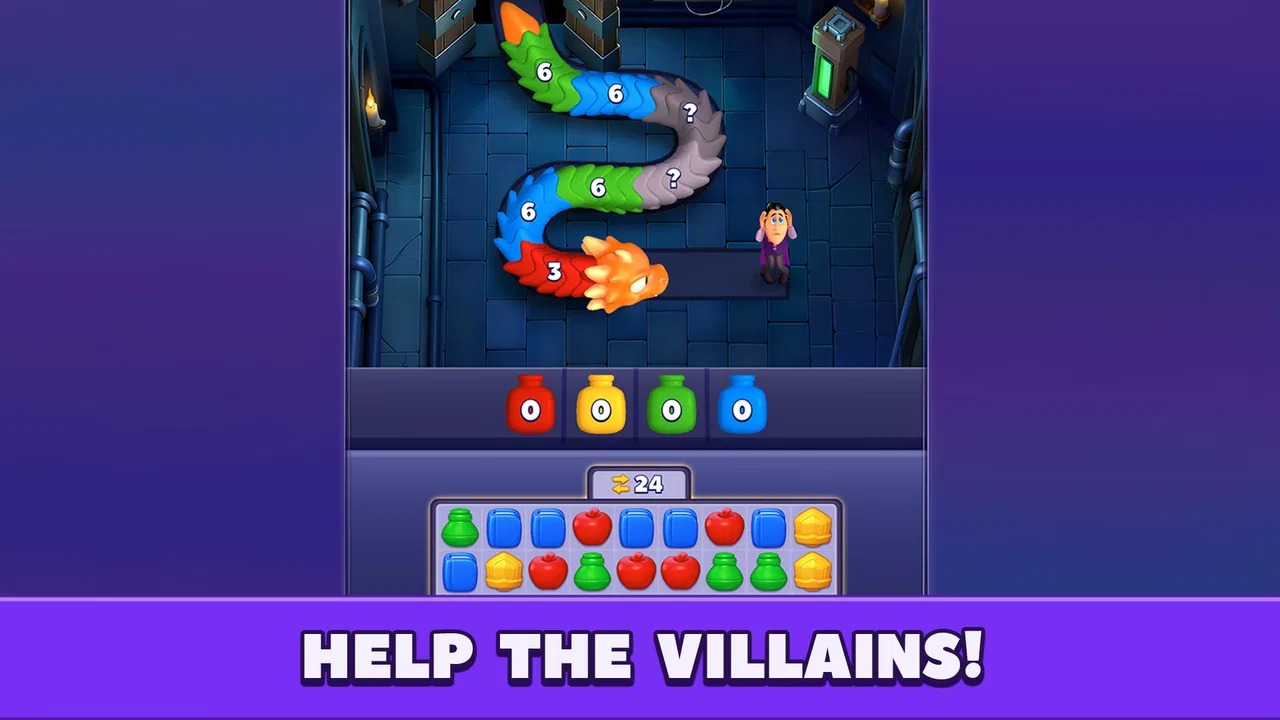
Match Villains
- 4.6
- Rating
- 10.00M
- Installs
- Free
- Price

 Analysis by App-foxy
I went into Match Villains expecting a familiar match-puzzle game with a playful criminal theme, and that is broadly what I found: a light, easy-to-start puzzle game that wraps its matching challenges in a neighborhood of mischievous characters. My overall impression is positive, but with an important qualification. It works best as a casual game for short sessions, not as a deep strategy experience or a replacement for more demanding puzzle games.
The central appeal is simple. You match pieces, solve puzzles, and help the game's friendly villains carry out their heists. The presentation gives the usual matching formula a little personality, while the short, self-contained nature of the puzzles makes it comfortable to play when I have only a few spare minutes. I can open it while waiting for an appointment, play a handful of levels, and put it away without needing to remember a complicated story or control system.
That accessibility explains much of its broad appeal. The game is free to start, rated for Everyone, and made by Good Job Games. It is listed as a puzzle game rather than an action or adventure title, so the emphasis stays on arranging matches and working through challenges instead of reflex-heavy controls. If you want something friendly and immediately understandable, this is an inviting choice.
You May Also Like

 Blood Strike: 2.5 Anniversary
Blood Strike’s Loadouts Turn Every Drop Into a Tactical Gamble
A close look at Blood Strike’s custom loadouts: how fast access to signature weapons reshapes its battle royale rhythm, rewards preparation, and narrows the gap between fights.

 Pandora - Music & Podcasts
Pandora’s Music Is Easy to Start, but Harder to Recover
Pandora’s strength is its low-effort path from a seed to a station. Its weak spot is how much confidence it asks you to place in connection, setup, and quiet recovery.

 8 Ball Pool
 Is Built on Rivalries, Rematches, and Routine
A close look at the rivalries, rematches, shared routines, and unanswered safety questions that turn a quick pool match into a persistent mobile community.

 Samsung Music
’s Quiet Strength Is Playing What You Already Own
Its reach comes less from spectacle than from dependable access to a personal library. That simplicity is both the app’s strongest retention engine and its ceiling.

 AccuWeather: Weather Radar
AccuWeather Review: A Quick, Clear Forecast for Everyday Decisions
For everyday plans, the best forecast is the one you can understand quickly. AccuWeather makes rain timing, radar, and local conditions easy to act on, with a few trade-offs.

 Hill Climb Racing
Why Hill Climb Racing Still Turns Crashes Into One More Run
A tiny car, a bumpy hill and one more upgrade: Hill Climb Racing keeps resurfacing because its simple chaos makes every near-miss feel personal.
More From Our News Desk



How the matching and heist idea works in practice
I find the appeal here is how the matching gives each brief session a small purpose: progress through puzzles is tied to the villains’ heist-themed neighborhood, rather than being only a sequence of boards. That framing is the starting point for judging whether its familiar puzzle loop feels fresh enough for you.
A familiar puzzle loop with a more playful wrapper
The basic loop is deliberately approachable. I look at the board, identify useful matches, clear pieces, and try to complete the objective before the available moves become a problem. That structure is familiar to anyone who has played a modern match puzzle, but the villain neighborhood gives the activity a more distinctive reason to continue. Rather than feeling like an endless series of disconnected boards, the heist framing gives the levels a small sense of purpose.
I especially like that the theme does not make the game intimidating. “Villains” here feels cartoonish and mischievous rather than dark, which fits the Everyone age rating. The characters and premise are designed to make the puzzles feel cheerful, not threatening. Parents looking for a simple game for a child can understand the appeal, although the presence of optional purchases still makes it sensible to supervise spending on a shared device.
The controls are the kind of thing I could understand without a tutorial-heavy introduction. That matters on mobile, where a game loses me quickly if it asks me to learn too many gestures before showing me why the process is fun. Match Villains gets to the matching quickly, and the heist theme supplies the extra flavor around it.
Where the game feels strongest
The strongest part of the experience is its low friction. I do not need a long uninterrupted session, a powerful phone, or previous knowledge of the story. The game is also easy to explain to another person: match the villains' puzzle pieces, solve the board, and keep moving through the neighborhood. That clarity makes it suitable for casual players who normally avoid games with dense menus or complicated systems.
Another strength is the balance between recognizable rules and a specific identity. There are many match games available, and a bare grid of colored pieces can feel interchangeable. Match Villains at least gives the process a memorable setting. The idea of helping an eccentric group of criminals with friendly heists is more characterful than a purely decorative theme, because it connects the puzzle progress to an ongoing fantasy.
For me, the game is most enjoyable when I treat it as a small daily distraction rather than a challenge that must occupy my full attention. A realistic use case is a commute with several short pauses: I can start a level, make a few thoughtful matches, stop when I reach my destination, and return later. It also suits the end of a busy day, when I want something interactive but do not have the energy for a long role-playing game or a competitive match.
Small decisions matter more than fast tapping
One useful habit is to pause before making the first obvious match. In these games, the most visible move is not always the most valuable one. I get better results by checking whether a match can create a larger combination, open a blocked area, or leave pieces positioned for the next turn. That extra second changes the game from random tapping into a modest planning exercise.
I also try to work from the lower part of the board when the layout allows it. Clearing pieces underneath can cause new pieces to fall into useful positions, while matching at the top may solve the immediate problem without improving the rest of the board. This is not a dramatic advanced system, but it is the kind of practical adjustment that makes later puzzles feel less dependent on luck.
A third tip is to save powerful opportunities until they solve a real problem. It is tempting to trigger a useful combination as soon as it appears, especially when the animation looks satisfying. I found that holding back can be better when the board has a difficult corner or an objective that requires several pieces to disappear. The game is more rewarding when I use these moments to shape the board rather than simply clear whatever is closest.
The progression is friendly, but not especially deep
The early experience is easy to enter, which is a benefit for new players and younger audiences. The trade-off is that experienced match-game players may recognize the formula immediately. If you have spent a lot of time with established puzzle titles, the basic act of matching will not feel revolutionary. The villains and heist setting add charm, but they do not automatically turn every board into a fresh strategic puzzle.
That distinction is important when deciding what to download. I would recommend it to someone who wants approachable entertainment with a bit of character. I would be less enthusiastic about it for a player searching for elaborate planning, a serious competitive ladder, or a story with substantial narrative development. Its appeal comes from polish, accessibility, and theme rather than from reinventing the puzzle category.
Free access and the purchase question
The game is free to download, which makes it easy to try without committing money at the start. Optional purchases range from $0.99 to $99.99 per item, so the possible spending range is wide. I would not judge the whole experience by the existence of purchases alone, but I would approach them carefully, particularly if a child is playing or if you tend to spend impulsively when a level becomes frustrating.
My advice is to decide in advance whether you are treating the game as a free casual pastime. If the answer is yes, play patiently, accept that some progress may take another attempt, and avoid turning every difficult board into a reason to buy help. The most satisfying moments come from noticing a better move, not from removing every obstacle immediately.
This is also where Match Villains differs from a traditional paid puzzle game. A one-time purchase usually gives a clearer sense of what the full cost will be, while a free-to-start game asks the player to manage optional spending over time. If predictable pricing matters more to you than instant access, a premium puzzle alternative may be a better fit. If you prefer trying before paying, the free entry point is a genuine advantage.
What the numbers say about its audience
The game has reached over 10 million installs and holds a 4.6 average from around 224 thousand ratings, with roughly 5.9 thousand written reviews. Those figures suggest that the simple format and friendly theme have found a substantial audience. They do not guarantee that every player will enjoy the same pace, but they do make it easier to see Match Villains as an established casual option rather than an obscure experiment.
It was released on November 12, 2024, and the current version is 6854, with Android 10 as the minimum operating system. In practical terms, that means users on older Android devices should check compatibility before planning to play. On a supported phone, the main question is less about learning the controls and more about whether the match-puzzle loop holds your attention after the novelty of the neighborhood wears off.
Where the experience can lose momentum
The biggest limitation is repetition. Matching games naturally rely on a repeated action, and a theme can only do so much to disguise that structure. I enjoyed the first sessions because the combination of simple boards and villain characters felt fresh. After longer play, I became more aware that the core activity remained similar from level to level. Players who need constant mechanical surprises may find the rhythm too predictable.
The other weakness is that casual accessibility can reduce the sense of accomplishment for puzzle experts. A game that is welcoming to a child or a first-time player may not provide enough resistance for someone who wants to study every board deeply. That is not a design failure, but it does define the audience. Match Villains wants to be inviting first and demanding second.
I also think the heist premise could have been a stronger reason to keep playing if the player is looking for a story-driven adventure. The setting gives the puzzles context, yet I would not approach this as a narrative game. The characters and neighborhood are there to support the matching loop, not to replace it with a long-form plot.
Who should play it, and who should skip it
I would recommend Match Villains to casual puzzle fans, families looking for an easy-to-understand mobile game, and anyone who enjoys short sessions with a colorful theme. It is particularly suitable for players who like the familiar satisfaction of clearing a board but want a little more personality than a generic collection of levels can provide.
It is also a reasonable choice for someone returning to mobile games after a long break. The controls and premise are not difficult to grasp, and there is no need to learn a large world before the first puzzle becomes enjoyable. If you are introducing a child to puzzle games, the Everyone rating is reassuring, though I would still keep an eye on the purchase options and the amount of time spent playing.
I would skip it if your priority is a one-time, fully paid experience with no optional spending decisions. I would also look elsewhere if you want competitive multiplayer, complex logic puzzles, or a long story with meaningful character development. Traditional brain-training apps may suit someone who wants abstract logic exercises, while premium puzzle games may be preferable for players who dislike the free-to-start model. Match Villains is best when its lightness is a feature, not a compromise.
My final take after playing
Match Villains is a pleasant, accessible match-puzzle game that succeeds through charm and convenience rather than ambition. Good Job Games has built an experience that is easy to pick up, comfortable in short bursts, and more memorable than a completely theme-free matching board. The friendly villain concept gives the familiar action a reason to feel connected, and the Everyone rating makes its tone broadly approachable.
At the same time, I would keep expectations realistic. This is not the game I would choose when I want an intricate puzzle system or a substantial adventure. Its repeated matching loop can become familiar, and the wide range of optional purchase prices means players should decide how they want to spend before frustration influences them. Those are meaningful considerations, not minor footnotes.
For my own recommendation, I would tell a friend to try it if they want a free puzzle game for waiting rooms, commutes, relaxed evenings, or occasional family play. I would suggest playing thoughtfully rather than rushing through obvious matches, saving strong combinations for difficult board areas, and treating purchases as optional rather than necessary. With that mindset, Match Villains is an enjoyable little neighborhood to visit whenever I want a quick, cheerful puzzle break.
FAQs for Match Villains
01What is the main objective of Match Villains?
Match Villains is a strategic puzzle game where players match different villain characters to unleash combos and defeat heroes. The objective is to clear levels by completing specific goals, often involving strategic thinking to maximize the power of villainous moves and progress through increasingly challenging stages.
02Is Match Villains free to play?
Yes, Match Villains is free to download and play. However, it offers in-app purchases for players who wish to enhance their gaming experience with additional features, power-ups, or to remove ads. These purchases are optional and not necessary to enjoy the core gameplay.
03Are there any age restrictions for playing Match Villains?
Match Villains is suitable for players aged 10 and above due to its strategic gameplay and cartoonish villain themes. The game includes mild fantasy violence, so parental guidance is recommended for younger players to ensure the content is appropriate.
04Can I play Match Villains offline?
Match Villains requires an internet connection for initial download, updates, and accessing certain features like leaderboards and special events. However, once installed, many levels can be played offline, making it convenient for on-the-go gaming without needing constant connectivity.
05Does Match Villains support multiplayer or social features?
Match Villains includes social features where players can connect with friends, share achievements, and compete on leaderboards. While it doesn’t have direct multiplayer gameplay, these social elements encourage friendly competition and community engagement among players.
Pros
- Engaging storyline with unique villains.
- Smooth graphics and immersive gameplay.
- Regular updates with new content.
- Interactive community and support.
- Diverse challenges keep players interested.
Cons
- In-app purchases can be pricey.
- Occasional lag on older devices.
- Requires constant internet connection.
- Limited character customization options.
- Ads can be intrusive at times.

Match Villains
Gallery